How to Lose Belly Fat Without Losing Muscle
There is a wrong assumption buried in this question and a very good one, and they are worth separating before anything else.
The wrong one is that you get to choose where the fat comes off. Largely you do not — the evidence on targeting a specific area is messier than the confident claims on either side, and I went through it in the article on measuring belly fat and what the number means.
The good assumption is the other half: that you can influence whether what you lose is fat or muscle. That part is genuinely well studied, and the answer is more specific than eat more protein.
The clearest trial on the question
Twenty-four elite athletes were randomised to lose weight at two different speeds: 0.7 % of body weight per week, or 1.4 %. Both groups did four resistance training sessions a week. Both ended up losing almost exactly the same total: 5.6 % and 5.5 % of body weight.
What differed was what that weight was made of.
Fat mass fell by 31 % in the slow group and 21 % in the fast group. And lean body mass rose by 2.1 % in the slow group while it was essentially unchanged in the fast one, at −0.2 %. The difference between groups was statistically significant.
Same number on the scale. One group lost more fat and built muscle doing it; the other did neither. The authors' conclusion was that athletes who want to keep gaining while losing weight should aim for about 0.7 % a week.
And the trial that complicates it
If the story ended there, every article would say go slow, and most of them do. Here is the one they leave out.
The TEMPO trial randomised 101 postmenopausal women with obesity to severe or moderate energy restriction and followed them for a year. The severe group lost more weight, more whole-body lean mass — a difference of 1.2 kg — and more thigh muscle area.
That sounds like confirmation until you read the next sentence. Those losses were proportional to total weight lost, and there was no difference in grip strength between the groups. The severe group also lost more fat, more abdominal subcutaneous fat and more visceral fat.
So the rate of loss did not, by itself, make the composition worse. It made everything bigger, in proportion.
What actually differed between the two
Put the trials side by side and one difference stands out: the athletes were lifting four times a week. The TEMPO intervention was a dietary one.
That is the most plausible reading, and I want to be clear that it is my reading rather than something either trial set out to test. Neither study isolated resistance training as the variable. But it is the obvious candidate, and it matches what the rest of the literature keeps finding: the training signal is what tells the body to keep the muscle.
It also reframes the practical question. If you are asking how fast to lose weight, you may be optimising the smaller lever while leaving the bigger one alone.
Protein, and the honest version of the number
You will see protein targets quoted everywhere, usually without the conditions attached. Here are the conditions.
A systematic review looked at energy-restricted, resistance-trained athletes and concluded that their protein needs are likely 2.3 to 3.1 g per kg of fat-free mass, scaled upwards with how severe the restriction is and how lean the person already is.
Now read who that applies to: adults, resistance training for more than six months, body fat at or below 23 % for men and 35 % for women, in a deficit. The review found six studies, covering 13 groups. That is a narrow, small evidence base, and it is not a recommendation for a general adult who has started walking more.
The internet rounds this to eat more protein. Directionally that is fine. Numerically it is not what the paper says, and quoting 3 g per kilogram at someone who has never lifted is using a specialist finding as if it were general advice.
One more line from that review is worth more than the number. Body fat percentage fell in all 13 groups — but fat-free mass also fell in nine of the 13. Losing some lean mass while dieting is the normal outcome, not a sign you did it wrong.
What to actually do
Lift two or three times a week. On the evidence above this is the variable most likely to be doing the work, and it is the one most of these articles treat as optional. If the worry is that lifting will not touch the belly itself, a meta-analysis of randomised trials found aerobic training, resistance training and the two combined all reduced abdominal subcutaneous fat compared with doing nothing.
Keep the deficit moderate rather than dramatic. The athlete trial supports it directly; TEMPO suggests the cost of going faster is proportional rather than catastrophic. Either way, modest is the safer default, and it is easier to sustain.
Eat more protein than you probably do, without adopting an athlete's number unless you are an athlete. The direction is well supported. The specific figure is not general advice.
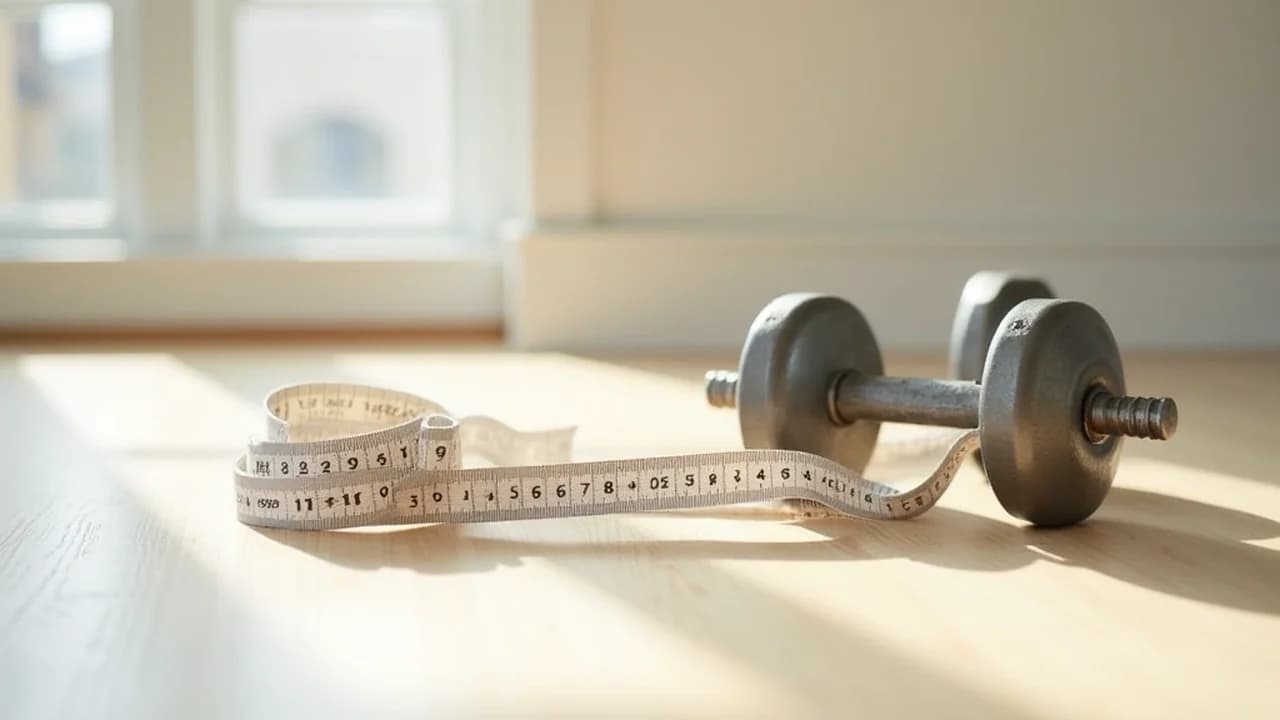
Measure your waist, not your weight. This matters more here than anywhere else, because the scale cannot distinguish fat from muscle — which is the entire premise of your question. A tape measure every twelve weeks tells you something the scale structurally cannot.
And expect to lose a little lean mass anyway. Nine of 13 groups did, in a review of people doing everything right.
When this is the wrong article
Weight coming off when you are not trying to lose it, or strength dropping quickly without a change in training, is a medical question rather than a programming one.
And if the thought of eating less is tangled up with something harder than body composition, that is worth talking to someone about. Deficit advice is the wrong tool for that, and it can make things considerably worse.
What we could not verify
Nothing here was tested. This is drawn from published research.
The athlete trial had 24 participants, all elite. People who already train four times a week, respond well to training and have low body fat are not a general population, and a 2.1 % gain in lean mass during a deficit is not what most people should expect.
TEMPO studied postmenopausal women with obesity, which is equally specific in the other direction. Neither trial describes the average reader.
The two trials point different ways on the rate of weight loss, and I have not resolved that. I have presented the tension and offered resistance training as the likely explanation. That explanation is my inference. Neither study tested it.
The protein review covers six studies in lean trained athletes. Its numbers should not be lifted out of that context, and I have tried not to.
Three of the four sources were read as abstracts only. All three are paywalled.
I am not a doctor, a dietitian or a coach.
Sources
- Effect of two different weight-loss rates on body composition and strength and power-related performance in elite athletes (Garthe et al., Int J Sport Nutr Exerc Metab, 2011, n = 24) — abstract only
- Effect of weight loss via severe vs moderate energy restriction on lean mass and body composition among postmenopausal women with obesity: the TEMPO Diet randomized clinical trial (JAMA Netw Open, 2019, n = 101) — abstract only
- A systematic review of dietary protein during caloric restriction in resistance trained lean athletes: a case for higher intakes (Helms et al., Int J Sport Nutr Exerc Metab, 2014) — abstract only
- The effect of aerobic and resistance training and combined modalities on subcutaneous abdominal fat: systematic review and meta-analysis of randomised clinical trials
Keep reading
Why Am I So Fatigued After Working Out?
The lactic acid explanation is wrong, soreness and fatigue are different things with different timelines, and the sports medicine consensus says the first thing to check is whether you are eating enough.

Move More Without a Gym Membership
You don't need equipment, a class schedule, or a commute to build a real movement habit. Here's what actually works.

Stomach Rolls When You Sit Down: What They Actually Are
Everyone selling you a fix for this is selling a fix for the wrong thing — and the fat you can see folding is the kind that matters comparatively least.

Why Am I So Irritable All the Time?
The largest synthesis of sleep and emotion research found something unexpected: losing sleep does not reliably make you angrier. It reliably takes away the good feelings, which from the inside is the same thing.